
Artist
-
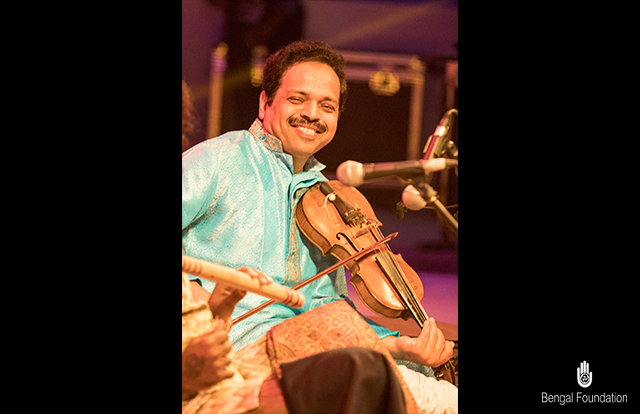
Ratish Tagde
Ratish Tagde is a violinist from India. He began his training under the guidance of his father S V Tagde. Ratish Tagde first started learning the tabla initially but eventually moved on to play the violin. Apart from being a performer, he also pursued the academic side of music, earning hisearned his undergraduate and post-graduate degrees from reputable universitiesin music. Tagde has performed in prestigious shows in India and abroad. He is the creator of the show ‘Insync’, and is the President of Musician’s Federation of India – affiliated to International Federation of Musicians & Member of International Music Council (Paris). In acknowledgement of his contributions to Indian classical music, Tagde was awarded with the National Excellence Awards and Asia Pacific Entrepreneurship Award in 2015.
-

Reenat Fauzia
Reenat Fauzia, born in 1967, comes of a world-renowned family of musicians. She is the grand daughter of Ustad Ayet Ali Khan, the legendary maestro of music of the subcontinent, brother of Surshamrat Ustad Alauddin Khan, the world famous maestro of music. Her father, Mr. Mobarak Hossain Khan is a distinguished musicologist and litterateur and mother Mrs. Fauzia Khan is a famous vocal artist. Her uncles Ustad Abed Hossain Khan, Ustad Bahadur Hossain Khan and music director Sheikh Sadi Khan are famous names in the same field. Her family originates from the village of Shibpur, Brahmanbaria district. The melody of music is something spontaneous in her being. She was attracted to music since her childhood. She drew her inspiration to play on Sitar out of her love for the wonderful instrument, which is a part of her family tradition. Reenat started her training in music lessons from her cousin Shahadat Hossain Khan, reputed Sarod player of Bangladesh. Later, she received her Guru-Shishya-Parampara music training from her cousin Ustad Khurshid Khan, a distinguished Sitar preceptor. She has been a disciple of her guru ( mentor) for more than twenty five years. Reenat completed a five years certificate course on Sitar from ‘Chhayanaut’, a pioneering music institute of Bangladesh. Reenat started playing Sitar in Bangladesh Television from 1987. She is an enlisted ‘Special’ grade classical artiste of Bangladesh Television and Radio Bangladesh. She also plays Sitar on other T.V. channels of the country. Her first c.d. on Sitar recital entitled ‘A Touch of Love’ was released in 2004. Later, four more entitled ‘Tribute to Grandfather Ustad Ayet Ali Khan’, ‘Haramanik’, ‘Raag Onurag’ and ‘Sweet Dreams’ have been added to her credit. As a member of the family of Ustad Alauddin Khan she is a follower of ‘Seni Maihar Gharana’ or ‘Seni Alauddin Gharana’. This is a new gharana introduced in the realm of Hindustani classical music by Ustad Alauddin Khan. Ustad Alauddin Khan was the disciple of Wazir Khan, a descendant of Mian Tansen, the great musician. He accepted the style of his guru and later on blended it with his own style and thus the subcontinent was enriched with a new and rich gharana. With the style of this gharana Reenat is practicingSitar intensively in quest for the excellence and zest for a life of music. The sheer virtuosity and melodies in her fingers, which she has achieved, have already attracted the attention of classical music lovers of the country. She got ‘Anonna Shirsho Dosh podok’ (Anonna top ten award) for her outstanding performance in Instrumental music in the year 2010. Reenat Fauzia has a brilliant academic career. She obtained her M.Sc. in Home Economics, from DhakaUniversity, and Post Graduate Diploma from ‘Mastricht School of Management’, Netherlands. Recently she has completed her M.Phil. thesis on Music entitled ‘Innovation and Development of Traditional Musical Instruments of Bangladesh’. She joined the Bangladesh Civil Service (Education) in 1993, and is at present an Associate Professor in the College of Home Economics. Reenat has a wide experience in traveling different countries.
-

Ronu Majumdar
Ranendranath Majumdar, popularly known as Ronu Majumdar, is a renowned Indian flautist. He is firmly rooted in the Maihar Gharana and trained under the guidance of his father Dr. Bhanu Majumdar, Pandit Lakshman Prasad Jaipurwale, Pandit Vijay Raghav Rao and Pandit Ravi Shankar. Majumdar has been felicitated with many accolades for his memorable performances worldwide. He composed music for India’s first I-Max film ‘Mystic India’ and has led a concert of 5,378 flautists on one stage called ‘Venu Naad’ under the banner of ‘Art of Living’. The event was recorded by the Guinness Book of World Records. Majumdar was awarded with an All India Radio Award, a Grammy Nomination, Aditya Vikram Birla Award, Lifetime Achievement Award by Sahara India, National Kumar Gandharva Award and Sangeet Natak Academy Award for his contribution to Hindustani Instrumental Music.
-

Ruchira Kedar
Ruchira Kedar is a leading young vocalist of the Gwalior-Jaipur gharana. Training initially under her father, Dilip Kale, Kedar learnt the intricacies of vocal music from Dr. Alaka Deo Marulkar. Thereafter, she received a residential scholarship at ITC Sangeet Research Academy, Kolkata, and received invaluable guidance from her current guru, Pandit Ulhas Kashalkar. She also took lessons in Thumri, Dadra, Hori, and Kajri from Vidushi Girija Devi. Ruchira is involved in student-mentoring at the Lalit Kala Kendra, University of Pune.
-

Sabir Khan
Sabir Khan is an Indian Classical musician known for his mastery of sarangi. He is the ninth generation musicians from his family to take up the instrument. Khan is the great grandson of Ustad Azim Khan, grandson of Ustad Gulab Khan, nephew of Hanif Khan and cousin of Dilshad Khan. He began his training under the guidance of his father, Ustad Sultan Khan, and uncle, Ustad Nasir Khan, and belongs to Sikar Gharana of Music. He has performed alongside his father and other great artists such as Ustad Zakir Hussain, Pandit Kumar Bose, Pandit Anindo Chatterjee, Ustad Gulam Ali, Talat Aziz, Asha Bhosle and The Hazards. Khan has also played in several feature films like Chameli, Rog, Dor, Anwar, Sanwariya, Chhodon Naa Yaar, Jodha Akbar and more recently Amma.
-

Saket Sahu
Born on July 23, 1986, Saket Sahu learnt the violin for 15 years from Pandit Radhakrishna Jha, from the age of 5. He has completed his MA in Music (Violin) from Indira Kala Music University, Khairagarh. A recipient of ‘Sur Ratna’ and gold medal from Bhatkhande Lalit Kala, he also won the All India Radio music competition in 2006, ITC Sangeet Research Academy Promising Artistes award in Mumbai (2007), ‘Surmani’ from Sur Singar Samsad Mumbai (2007), National Scholarship (2007-2008) and the Kal Ke Kalakar award from Abhinav Kala Parishad, Bhopal. He has performed in several parts of India. Since May 2009, he has joined the ITC Sangeet Research Academy as a disciple of Pandit Ajoy Chakrabarty under whom he is learning the gayaki ang. He is now an A grade scholar here.
-

Sameehan Kashalkar
Sameehan Kashalkar is one of the youngest upcoming musicians of the Gwalior gharana. He is the son and disciple of one of India’s most renowned vocalists, Pandit Ulhas Kashalkar. Kashalkar is a Scholar at the ITC Sangeet Research Academy and is undergoing training in Thumri and other light classical forms from the legendary Vidushi Girija Devi of the Banaras tradition. He has performed in major festivals including the ITC Sangeet Sammelans in Kolkata, Hyderabad, Mangalore; Pandit Jitendra Abhisheki Sangeet Mahotsav in Pune, the Asian Music Circuit in London, renowned ‘Darbar Festival’ in London, Sawai Gandharva Festival in Pune, SIFAS Festival in Singapore and Malaysia, amongst many others. Kashalkar currently teaches music at the Bengal Parampara Sangeetalaya, in Dhaka.
-

Sandip Bhattacharjee
Born in 1980, Sandip Bhattacharjee began his training under his mother Krishna Bhattacharya at the age of four and continued his taalim under Amita Dasgupta. In May 2002 he became a residential scholar at the ITC Sangeet Research Academy under the guidance of Ustad Mashkoor Ali Khan. An 'A' graded artiste of AIR and Doordarshan, he has participated in several major concerts in India, including the Dover Lane Conference. Sandip regularly conducts workshops in Guwahati and Digboi, Assam. As of June 2012, Sandip has become a Musician Scholar of the Academy.